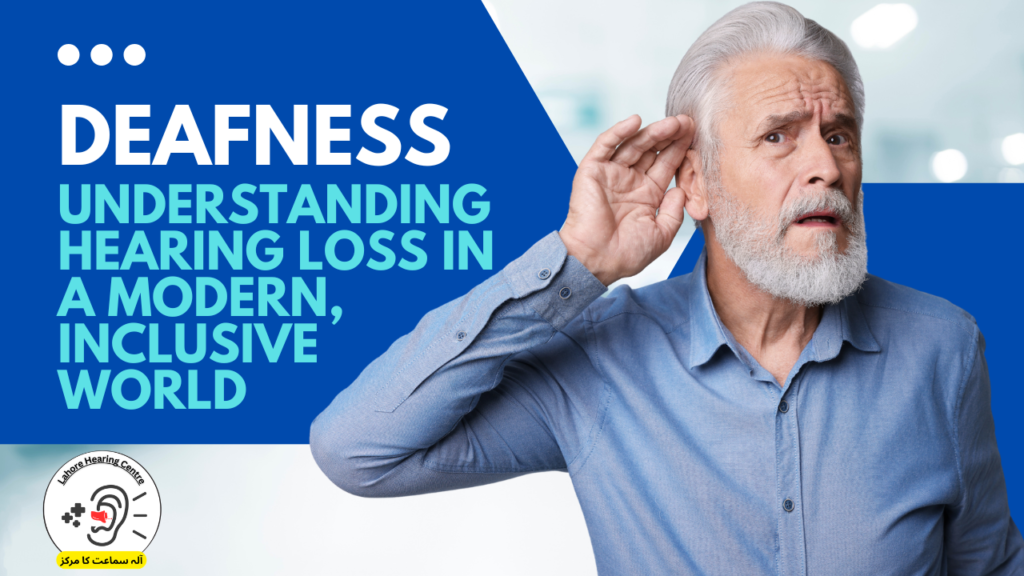
Deafness is not merely a medical diagnosis. It is a lived experience, a spectrum of realities, and for many, a cultural identity. In today’s world, where communication moves at lightning speed and sound dominates daily interactions, understanding deafness becomes not just important—but essential.
This comprehensive guide explores deafness from medical, social, cultural, and technological perspectives. It is written to provide clarity, depth, and practical insight while maintaining a professional yet engaging tone. Whether you are researching the topic, supporting someone with hearing loss, or seeking personal understanding, this article offers everything you need in one place.
What Is Deafness? A Clear and Comprehensive Definition
Deafness refers to partial or complete loss of hearing. It may affect one ear (unilateral) or both ears (bilateral), and it can range from mild hearing difficulty to profound hearing loss where no sound is perceived.
However, deafness is more than the absence of sound. It can influence communication methods, education, social interaction, career opportunities, and identity formation.
In medical terms, deafness is categorized as a type of hearing loss. In cultural contexts, especially within the Deaf community, it represents belonging to a linguistic and cultural minority that uses sign language as a primary mode of communication.
Understanding both dimensions is essential.
Types of Deafness
Deafness is not a single condition. It varies depending on the part of the auditory system affected and the severity of the hearing loss.
1. Conductive Deafness
Conductive hearing loss occurs when sound cannot efficiently travel through the outer or middle ear. This may be caused by:
- Ear infections
- Fluid in the middle ear
- Earwax blockage
- Perforated eardrum
- Abnormal bone growth
This type of deafness is often temporary and can sometimes be treated medically or surgically.
2. Sensorineural Deafness
Sensorineural hearing loss is caused by damage to the inner ear (cochlea) or the auditory nerve. It is usually permanent and may result from:
- Aging (presbycusis)
- Noise exposure
- Genetic factors
- Certain medications
- Viral infections
This is the most common type of permanent deafness.
3. Mixed Deafness
Mixed hearing loss is a combination of conductive and sensorineural deafness. It involves problems in both the outer/middle ear and the inner ear.
4. Central Deafness
Central hearing loss occurs when the brain has difficulty processing sound signals, even if the ears function properly. This type is less common but affects sound interpretation rather than sound detection.
Levels of Hearing Loss
Deafness is also classified by severity:
- Mild hearing loss – Difficulty hearing soft speech.
- Moderate hearing loss – Difficulty hearing normal conversation.
- Severe hearing loss – Very limited hearing of speech.
- Profound deafness – Almost no perception of sound.
Each level impacts communication differently and may require different support strategies.
Causes of Deafness
Deafness can occur at any stage of life and may be congenital (present at birth) or acquired later.
Congenital Causes
- Genetic inheritance
- Premature birth
- Birth complications
- Infections during pregnancy (such as rubella)
Acquired Causes
- Prolonged exposure to loud noise
- Head injuries
- Infections (meningitis, measles)
- Aging
- Ototoxic medications
- Chronic ear infections
Modern lifestyle factors, especially excessive noise exposure through headphones and industrial environments, have increased the risk of early hearing loss.
Early Signs and Symptoms of Deafness
Recognizing early signs can significantly improve outcomes, especially in children.
In Infants:
- No reaction to loud sounds
- Delayed speech development
- Not turning toward sound sources
In Adults:
- Frequently asking others to repeat themselves
- Increasing TV volume excessively
- Difficulty following conversations in noisy places
- Ringing in the ears (tinnitus)
Early diagnosis allows for timely intervention and improved communication development.
The Cultural Perspective: Deaf vs deaf
One of the most important distinctions in understanding deafness is the difference between “deaf” and “Deaf.”
- deaf (lowercase) refers to the medical condition.
- Deaf (uppercase) refers to individuals who identify with the Deaf community and use sign language as their primary language.
The Deaf community has its own culture, values, humor, traditions, and social norms. For many members, deafness is not seen as a disability but as a difference.
This perspective shifts the conversation from limitation to identity.
Communication Methods Used by Deaf Individuals
Communication varies widely depending on personal preference, education, and access to resources.
1. Sign Language
Sign language is a fully developed natural language with its own grammar and syntax. Different countries have different sign languages, such as:
- American Sign Language (ASL)
- British Sign Language (BSL)
- Pakistani Sign Language (PSL)
Sign language is not universal; each system has its own structure.
2. Lip Reading
Lip reading involves interpreting speech by observing mouth movements. However, only about 30–40% of English speech is visible on the lips, making it challenging without additional context.
3. Written Communication
Text messaging, email, and live captioning have greatly enhanced accessibility.
4. Speech and Auditory Training
Some deaf individuals use hearing devices and participate in speech therapy to develop verbal communication skills.
Assistive Technologies for Deafness
Technology has transformed the lives of people with deafness.
Hearing Aids
Hearing aids amplify sound and are suitable for mild to severe hearing loss.
Cochlear Implants
Cochlear implants bypass damaged parts of the ear and directly stimulate the auditory nerve. They are typically used for severe to profound hearing loss.
Bone-Conduction Devices
These transmit sound through bone vibration directly to the inner ear.
Captioning and Speech-to-Text Apps
Real-time transcription apps and video captioning provide communication support in education and business settings.
Technology continues to close communication gaps and create more inclusive environments.
Education and Deafness
Education systems for deaf individuals vary:
- Mainstream schools with accommodations
- Specialized schools for the Deaf
- Bilingual-bicultural education models
Access to early language exposure—whether sign language or spoken language—is critical for cognitive and emotional development.
Research consistently shows that early intervention dramatically improves language acquisition outcomes.
Employment and Workplace Inclusion
Deaf individuals can succeed in virtually any profession when given equal access and appropriate accommodations.
Workplace support may include:
- Captioned meetings
- Sign language interpreters
- Visual alert systems
- Written communication protocols
Inclusive policies benefit not only deaf employees but entire organizations.
Social and Emotional Aspects of Deafness
Deafness can affect mental health, especially when individuals experience social isolation.
Common challenges include:
- Communication barriers
- Limited access to information
- Misunderstanding from others
However, strong community connections and accessible environments significantly reduce these challenges.
Social acceptance and awareness play a powerful role in emotional well-being.
Breaking Myths About Deafness
Several misconceptions still exist:
- Myth: Deaf people cannot speak.
- Reality: Some can and do, depending on training and preference.
- Myth: All deaf people use sign language.
- Reality: Communication methods vary widely.
- Myth: Deafness equals low intelligence.
- Reality: Hearing ability has no connection to intellectual capacity.
Education and awareness are key to dismantling these myths.
Preventing Deafness
While not all deafness can be prevented, some steps reduce risk:
- Avoid prolonged exposure to loud noise
- Use ear protection in noisy environments
- Limit headphone volume
- Seek medical care for ear infections promptly
- Get regular hearing screenings
Hearing conservation should begin early in life.
The Future of Deafness and Accessibility
Advancements in artificial intelligence, wearable technology, and biomedical research continue to reshape the landscape of deafness.
Innovations such as:
- AI-powered real-time translation
- Improved implant technology
- Smart hearing devices
- Universal design architecture
are making society increasingly accessible.
The future is not about “fixing” deafness—it is about expanding access.
Conclusion
Deafness is a complex and multifaceted experience that extends far beyond the absence of sound. It encompasses medical realities, cultural identity, technological innovation, and social inclusion. Understanding deafness requires both knowledge and empathy.
When society embraces accessibility, promotes early intervention, supports diverse communication methods, and respects Deaf culture, barriers begin to disappear. Deafness is not a limitation of human potential—it is a reminder that communication takes many forms, and diversity enriches us all.
Frequently Asked Questions (FAQ)
1. Is deafness always permanent?
No. Some types of deafness, particularly conductive hearing loss, can be temporary and treatable.
2. Can deaf individuals drive safely?
Yes. Deaf individuals often rely more on visual awareness, and studies show they drive as safely as hearing individuals.
3. Are cochlear implants suitable for everyone?
No. Suitability depends on the type and severity of hearing loss and medical evaluation.
4. Do all deaf people prefer sign language?
No. Communication preferences vary based on background, education, and personal choice.
5. Can hearing loss worsen over time?
Yes. Progressive hearing loss can occur due to aging, continued noise exposure, or underlying medical conditions.